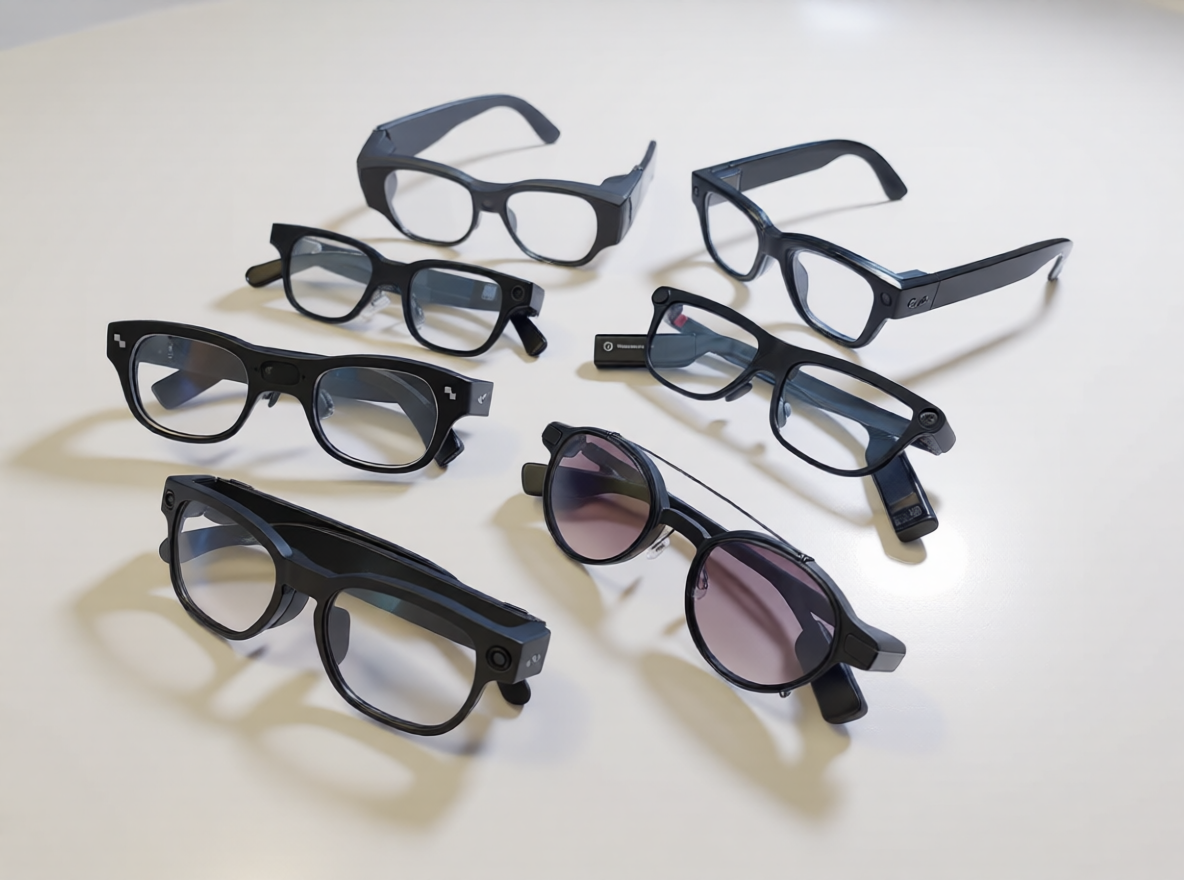
Today we have dozens of smart glasses on the market, each with its own size and feature set. They range from devices with full operating systems to minimal real-time OSes controlled by the phone over Bluetooth.
We can group them into three categories.
The Three Categories
GROUP 1 — Full OS: Standalone Apps
The first group runs full Android applications: Snap Spectacles 2024, INMO Air 3, and XREAL Aura. All three have very different SDKs. Snap Spectacles uses Lens Studio. XREAL Aura uses Android XR. INMO runs stock Android and they both support development with Antigravity or Android Studio.
GROUP 2 — Light Android OS: Phone + Optional On-Glasses App
The second group runs a light Android OS and includes the Meta Ray-Ban Display, RayNeo X3 Pro, and Rokid Glasses with Display. They all run on the Qualcomm Snapdragon AR1 processor. These glasses offer two development approaches. The first is to build a phone app that controls the display, buttons, camera, and audio via a custom SDK — typically supporting both iOS and Android. The second is to build a small Android app using the vendor SDK that runs directly on the glasses. In this space, RayNeo X3 Pro is the most open. Rokid requires a custom cable that isn't publicly available, and Meta doesn't offer this option at all.
GROUP 3 — Ultra-Light: Phone App Controls Everything
The third group is the ultra-light category: Even Realities G1 and G2, Mentra Live, Vuzix 100, INMO Go 3, and Meta Ray-Ban (non-display model). For these, you build an iOS or Android app using the vendor SDK that runs on the phone, controlling the display, speakers, and capturing button or touchpad input. Vuzix and Even Realities G1 use Mentra OS 2.0. Even Realities G2 and Mentra Live use Mentra OS 3.0 in addition of their own SDK. Meta's SDK is standalone and quite limited in features. All support both iOS and Android.
Smart Glasses Comparison Table
GROUP 1: Full OS — Standalone Apps
| Device | Processor | OS | Phone | Glasses | Display | Speaker | Camera | Edge AI |
|---|---|---|---|---|---|---|---|---|
| Snap Spectacles 2024 (5th gen) | Dual Snapdragon (models not disclosed) | Snap OS 2.0 | — | Lens Studio | LCoS waveguide, 46° diag, 37 PPD | yes | 4 (2 RGB + 2 IR) | SnapML + OpenAI cloud |
| INMO Air 3 | Qualcomm Snapdragon, 8 GB / 128 GB | Android 14 (IMOS 3.0) | — | Play Store (GMS) | Sony micro-OLED 1920x1080/eye, 36°, 600 nits, 120 Hz | yes | 16 MP, 120° | ChatGPT (cloud) |
| XREAL Aura | Snapdragon Reality Elite (puck) + XREAL X1S (glasses) | Android XR | via Puck | Android XR | Sony micro-OLED 1920x1200/eye, 70°, 120 Hz | yes | yes (count not confirmed) | Puck NPU + Gemini cloud |
GROUP 2: Light Android OS — Phone + Optional On-Glasses App
| Device | Processor | OS | Phone | Glasses | Display | Speaker | Camera | Edge AI |
|---|---|---|---|---|---|---|---|---|
| Meta Ray-Ban Display | Snapdragon AR1 Gen 1 | Meta (proprietary) | Device Access Toolkit | Web Apps (dev preview) | LCoS geometric waveguide 600x600, 20°, 90 Hz, 5,000 nits | yes | 12 MP, 3x zoom | Meta AI (cloud) |
| RayNeo X3 Pro | Snapdragon AR1 Gen 1, 4 GB / 32 GB | RayNeo AIOS (Android-based) | yes | Unity / Android ARDK | Full-color MicroLED waveguide 640x480, 30°, 3,500 nits avg / 6,000 peak | yes | 12 MP Sony IMX681 + spatial cam | Gemini (cloud) |
| Rokid Glasses | Snapdragon AR1 Gen 1 + NXP RT600 | Rokid (Android-based) | yes | SDK | Mono green MicroLED 480x398/eye, 30°, 1,500 nits | yes | 12 MP Sony IMX681, 109° | RT600 local voice + cloud |
GROUP 3: Minimal — Phone App Controls Everything
| Device | Processor | OS | Phone | Glasses | Display | Speaker | Camera | Edge AI |
|---|---|---|---|---|---|---|---|---|
| Even Realities G1 | Not disclosed | Even OS; MentraOS (3rd-party) | SDK | — | Mono green MicroLED waveguide | — | — | Phone (cloud) |
| Even Realities G2 | Ambiq Apollo510b (community teardown, unofficial) | Even OS; MentraOS (3rd-party) | SDK | — | Mono green MicroLED 640x350, 27.5°, 60 Hz, 1,200 nits | — | — | Phone (cloud) |
| Vuzix Ultralite Z100 | Not disclosed | Vuzix Connect; MentraOS (3rd-party) | SDK | — | Mono green MicroLED 640x480, 30°, 4:3, right eye | — | — | Paired phone |
| Meta Ray-Ban (Gen 2, no display) | Snapdragon AR1 Gen 1 | Meta (proprietary) | Device Access Toolkit | — | — | yes | 12 MP | Meta AI (cloud) |
| RayNeo iO | Not disclosed | RayNeo (proprietary) | SDK | — | Mono green MicroLED 23.5°, 1,300 nits | — | — | RayNeo AI / Gemini / ChatGPT / Claude / DeepSeek |
Legend
| Phone | App runs on the phone |
| Glasses | App runs on the glasses |
| yes / — | Supported / Not supported |
| via Puck / tethered | Companion device required |
| Cloud | Cloud-based AI |
| Hybrid | On-device + cloud |